Enslavement Trade and Encomienda
- Rosie Jayde Uyola

- Sep 14, 2025
- 4 min read
Learning Target: "I can explain the causes and effects of the transatlantic voyages"
Enslavement has occurred in many forms throughout the world, but the Atlantic enslavement trade -- which forcibly brought more than 10 million Africans to the Americas -- stands out for both its global scale and its lasting legacy.
Historical Context
The Middle Passage - 300 years in 2 minutes
Note 1619 arrival of enslaved people in Jamestown and the 1808 end of the international enslavement trade.
You can also infer why/when specific countries engage in the African slave trade.
As you watch, infer and notice the following:
Why do you think this map begins in 1520?
Where did the first African enslaved people arrive? Why is that?
In what year did the first African enslaved people arrive in what is considered the modern USA?
Why is the slave trade in the beginning of the video? When does it speed up? Why?
When do African enslaved people stop arriving in the modern USA?
Encomienda
The spread of Catholicism was the stated goal of the Spanish conquest of the Americas, but the Spanish also wanted to profit from their new territories. Once the treasures of Indigenous civilizations were looted, colonists turned to mining and plantation farming to make their fortunes, and they needed to find cheap labor to maximize their profits. In her early instructions for the governance of the colonies, Queen Isabella I of Spain required all Indigenous people to pay tribute to the crown or its representatives. The encomienda system was created as a result of this directive.
In this system, encomenderos were awarded the control of all the Indigenous people who lived in a defined territory and did not convert to Christianity. This power was usually awarded in recognition of special services to the crown. For example, as recognition for his conquest of the Aztec Empire, conquistador Hernán Cortés was awarded an encomienda territory that included 115,000 Indigenous inhabitants. Hernán’s power over the Indigenous people in his territory was practically absolute. He could demand tribute in the form of crops or currency. He could force them to construct forts and towns and work the mines and plantations. He could sexually exploit the women, and even sell the people who worked for him to other encomenderos. The horrors of life on the encomiendas would eventually spark outrage back in Spain.
This illustration comes from A Short Account of the Destruction of the Indies, Bartholomé’s firsthand account of the abuses he witnessed. Published in 1542, the illustrations were intended to shock readers.
This illustration centers the suffering of women and children. It also hints at the sexual exploitation Indigenous women experienced at the hands of their enslavers. Bartholomé’s work outraged readers in Spain and prompted the Spanish government to pass the New Laws in 1542. The New Laws aimed to free all Indigenous people from the encomienda system within a generation. This was not a definitive end to the exploitation of Indigenous people in the Spanish colonies, but it was an important step in addressing their oppression.

What do you see?
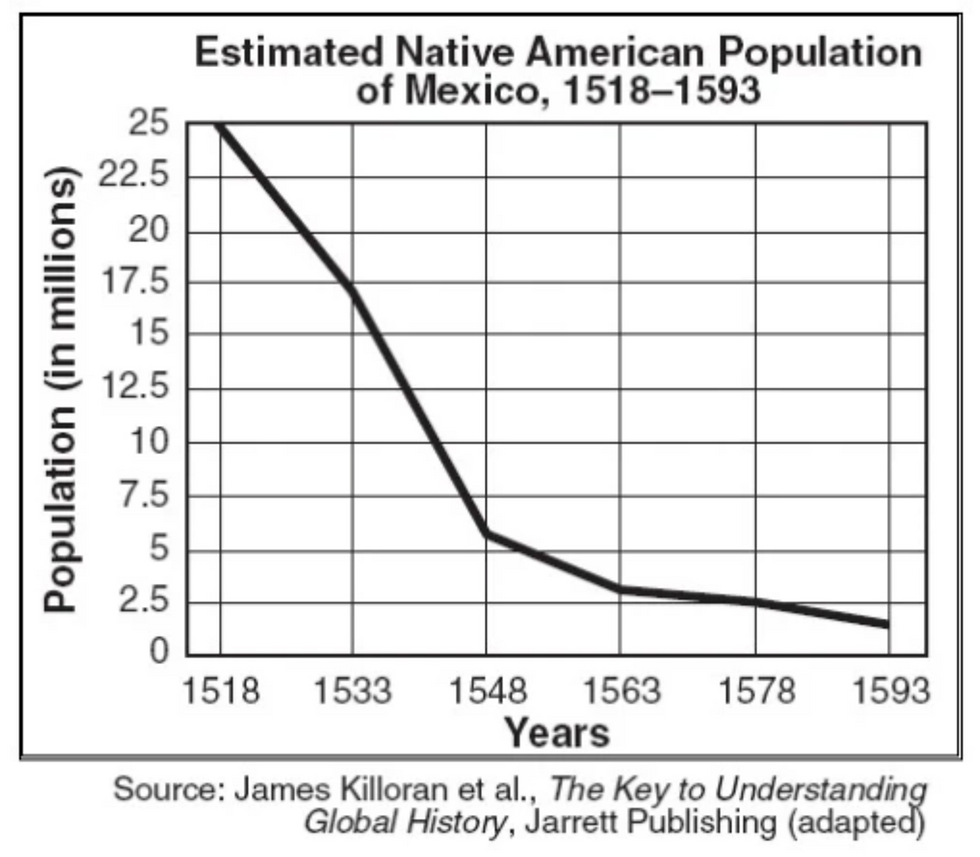
This Native American Population Graph shows the sharp decline in the Native American population. Notice that the African enslavement trade begins soon after the sharp decline.
Infer and analyze:
What is the relationship between the video and the graph?
What are the possible reasons as to why the Native American population sharply
declines? Cite a specific example.
Discuss the encomienda system (a grant by the Spanish king or queen that allowed a person to demand tribute and forced labor from the Indigenous people in a defined territory) and why the Native population declined during this time period.
Homework (choose one video and take notes in notebook)
Cultural Interactions Between Eureopeans, Native Americans, and Africans
Note: Father Paul LeJuene is a French Jesuit missionary
“You should try to eat their sagamité or salmagundi in the way they prepare it, although it may be dirty, half-cooked, and very tasteless. As to the other numerous things which may be unpleasant, they must be endured for the love of God, without saying anything or appearing to notice them. It is well at first to take everything they offer, although you may not be able to eat it all; for, when one becomes somewhat accustomed to it, there is not too much….You must bear with their imperfections without saying a word, yes, even without seeming to notice them. Even if it be necessary to criticize anything, it must be done modestly, and with words and signs which evince love and not aversion. In short, you must try to be, and to appear, always cheerful.” --Father Paul LeJuene, On the State of Christianity in New France, 1637
SAQ:
A. How does Father Paul LeJuene’s interactions with Native Americans differ from the interactions we learned about in New Spain?
B. How did interactions between Native Americans and Europeans cause change among each group? Cite 2 specific examples in your response.


